

Can Professional Cleaning Services Use Hypoallergenic Products?
The short answer is yes—and the best ones already do. If you live with allergies, asthma, or chemical sensitivities, choosing a cleaning company that stocks hypoallergenic products can make an enormous difference to your indoor air quality and daily comfort. Below, we break down why it matters, what to look for, and how Cove Cleaning approaches the issue.
Why Hypoallergenic Cleaning Products Matter
Standard cleaning solutions often contain fragrances, ammonia, and synthetic preservatives that can aggravate sensitive individuals. Many commercial cleaning products contain strong fragrances, ammonia, or harsh chemicals that can irritate allergies. Fragrances alone are among the top five known allergens and can readily trigger asthma attacks. Research has even shown that children with the highest exposure to cleaning chemicals during their first four months of life were 37 percent more likely to develop asthma than those with the least exposure.
The issue extends beyond those with existing conditions. Some of the most frequently used cleaning chemicals can cause allergies and asthma in adults and children who have never had them before. For the more than 100 million people in the United States with asthma or allergies, selecting the right cleaning products is critical.
What Makes a Cleaning Product Hypoallergenic?
Hypoallergenic cleaning products are specially formulated to minimize the risk of allergic reactions. They are typically free from harsh chemicals, fragrances, and other irritants commonly found in traditional cleaning products. Key characteristics include:
- Fragrance-free formulation — No synthetic perfumes or masking scents that release volatile organic compounds.
- No ammonia or chlorine bleach — Ammonia is classified as an Extremely Hazardous Substance by the EPA and is a known trigger for asthma and allergies.
- Free of preservatives like MIT and CMIT — Methylisothiazolinone (MIT) is a contact allergen linked to allergic reactions and inhalation toxicity, and has been restricted in the EU and banned in Canadian cosmetics.
- Plant-based or mineral-based active ingredients — Natural alternatives like white vinegar, baking soda, and hydrogen peroxide are effective and less likely to cause reactions.
- Dye-free — Synthetic colorants can cause contact dermatitis in sensitive individuals.
Third-Party Certifications to Look For
Not every product labelled "natural" is truly safe for allergy sufferers. There are no federal safety standards on most "natural" product categories, so you cannot assume a natural product is non-toxic or allergy-safe. To cut through marketing claims, look for recognised certification marks:
- Asthma & Allergy Friendly® Certification — Created by the Asthma and Allergy Foundation of America (AAFA) and Allergy Standards Limited (ASL), this programme tests household products against strict standards. Products that pass earn the certification mark, proving they are better suited for people with asthma and allergies. The certification evaluates ingredients for toxicological, allergenic, and sensitising purposes, analyses airborne chemicals during use, and measures allergen levels after use.
- EPA Safer Choice — Identifies products made with ingredients that are safer for human health and the environment.
- Green Seal / EcoLogo — Verify environmental and health claims through independent testing.
How Professional Cleaning Services Accommodate Allergies
Reputable professional cleaning companies can and do use hypoallergenic products upon request—or as their standard practice. Here is what a quality allergy-friendly cleaning service should offer:
- Custom Assessment — Reputable professional cleaning services should complete a custom assessment of your needs and build a plan to target problem areas accordingly.
- HEPA-Filter Equipment — HEPA filters trap at least 99.97 percent of particles as small as 0.3 microns, including dust, pollen, pet dander, and mould spores. Any serious allergy-focused service uses HEPA-filter vacuums to prevent allergens from becoming airborne during cleaning.
- Damp-Dusting with Microfibre — Lightly dampened microfibre cloths capture particles rather than dispersing them into the air.
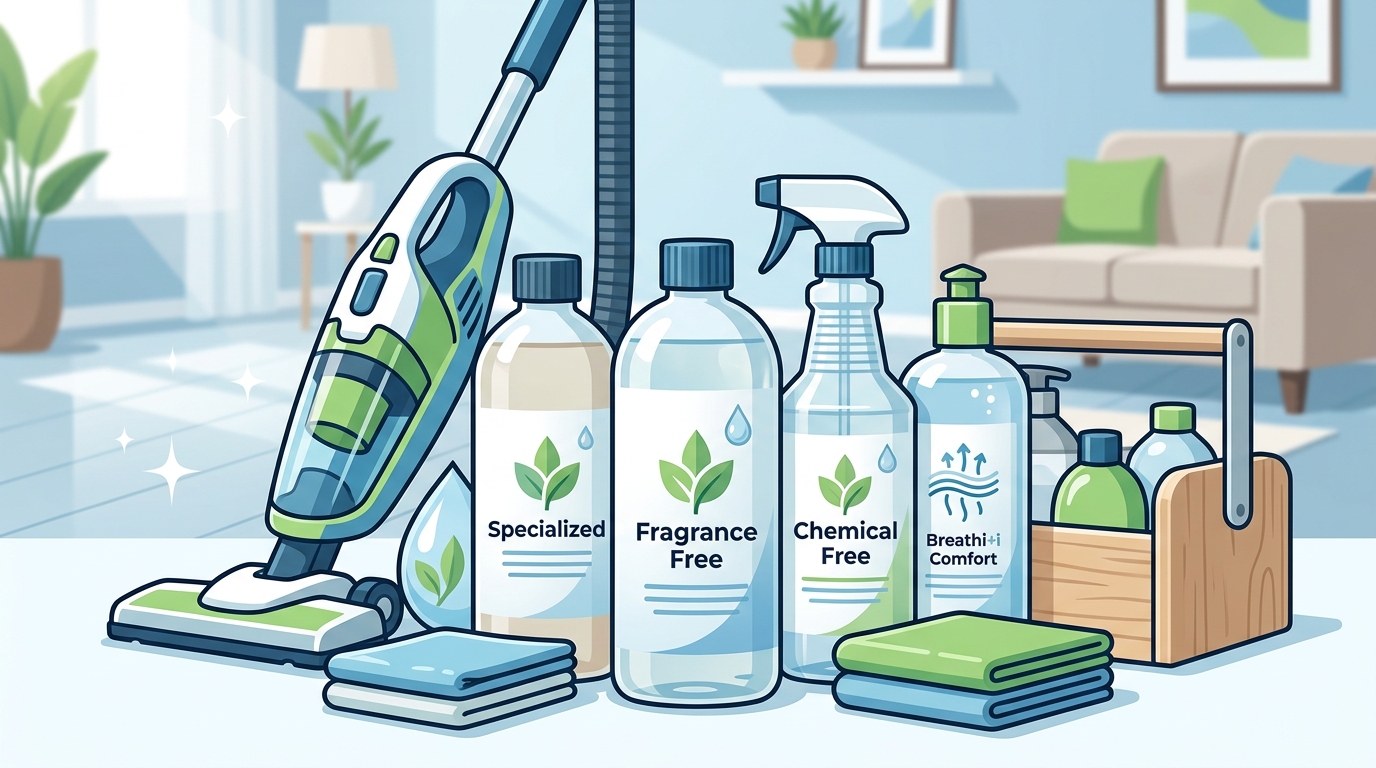
- Fragrance-Free & Certified Products — The service should be able to detail exactly which products and methods they use, and those products should carry recognised certifications.
- Specialised Treatments — Some services offer anti-allergen treatments for carpets, mattresses, and upholstery that can reduce allergens and airborne bacteria by more than 95 percent.
Questions to Ask Before Booking
When evaluating a cleaning company for allergy-friendly service, ask these questions:
- Do you carry fragrance-free and hypoallergenic product lines?
- What specific brands and certifications do your products hold?
- Do your vacuums use true HEPA filtration?
- Can I supply my own products if I have specific sensitivities?
- Are your staff trained in allergy-aware cleaning techniques?
- Is the service licensed and insured, and do you have experience working with allergy issues?
How Cove Cleaning Handles Hypoallergenic Requests
At Cove Cleaning, we believe every client deserves a clean home that does not compromise their health. Our approach includes:
- Default eco-friendly product line — We use plant-based, fragrance-free, dye-free cleaning solutions as standard.
- HEPA-filter vacuums on every job — Prevents allergens from recirculating during the clean.
- Open product transparency — We share full ingredient lists with clients on request so you know exactly what enters your home.
- Custom allergy plans — For clients with severe sensitivities, we build tailored cleaning protocols covering product selection, equipment, and scheduling frequency.
If you have specific product preferences or doctor-recommended solutions, our teams are happy to accommodate them.
Key Takeaways
- Professional cleaning services absolutely can—and should—use hypoallergenic products, especially for clients with allergies, asthma, or chemical sensitivities.
- Look for third-party certifications like Asthma & Allergy Friendly® rather than relying on vague "natural" or "green" labels.
- Effective allergy-friendly cleaning goes beyond products—it requires HEPA-filter equipment, damp-dusting techniques, and trained personnel.
- Always ask your cleaning provider to detail their products and methods before the first visit.
- Cove Cleaning offers hypoallergenic, fragrance-free cleaning as a standard part of our service.
Frequently Asked Questions
Are hypoallergenic cleaning products as effective as regular ones?
Yes. Modern hypoallergenic formulas are designed to clean effectively without relying on harsh chemicals. Many carry the same or better efficacy ratings from independent testing bodies like AAFA's certification programme, which evaluates allergen removal from surfaces after use.
Can I ask a cleaning service to use my own products?
Most reputable services will accommodate client-supplied products. At Cove Cleaning, we welcome specific product requests and can integrate them into your cleaning plan at no extra charge.
How often should allergy sufferers schedule professional cleaning?
For homes with significant allergen loads, carpet and upholstery should be professionally cleaned three to four times per year. General house cleaning on a weekly or biweekly schedule helps keep dust mites, pet dander, and pollen under control between deep cleans.
What chemicals should allergy sufferers avoid in cleaning products?
Key irritants to watch for include synthetic fragrances, ammonia, chlorine bleach, methylisothiazolinone (MIT), methylchloroisothiazolinone (CMIT), sodium lauryl sulphate (SLS), and ethoxylates. Checking ingredient labels and choosing certified products is the safest approach.
Is there a certification programme specifically for professional cleaning services?
Yes. The Asthma & Allergy Friendly® Certification Programme by AAFA and ASL certifies professional cleaning services. To earn certification, services must meet strict standards and be proven to remove allergens and dry quickly.